Showing posts with label comics. Show all posts

December 16, 2014

After the End

Four months ago, I found myself caught between several freelance projects leftover from the summer and a tidal wave of new homework: the beginning of my final year at school. One of those lingering projects was also one of the most satisfying: a comic for Geez magazine's apocalypse-themed winter issue. That issue is now on newsstands and I'm thrilled to be among so many strong and vital voices. I've been following Geez off and on since its inception (I actually remember buying the first issue). I've occasionally thought about contributing, but the timing was never right. I'm glad it finally worked out, even if I was pressed for time. Geez consistently pushes itself in worthwhile directions, and the writing in this issue in particular manages to be severely critical yet unabashedly hopeful. Just the dialectical imbalance I look for in a quasi-religious publication.

My own contribution is an odd one. When I first heard of the theme, I knew immediately that my comic would take aim at liberal suburbia, where the average church member's biggest discomfort on a Sunday morning revolves around the church parking lot. There is something apocalyptic even in this, something revelatory about a place that, despite some good intentions, is so often out of touch with what really matters, unaware of its role in safeguarding structures of oppression.

When I finally started working on my comic, I came to recognize that for many mainstream Christian groups obsessed with the End Times, there's an omnipresent, hermeneutical interplay between inside and outside. A claim to clarity and revelation–being able to read and interpret the "signs of the times" for what they really are–is perhaps what makes most apocalyptic fixations so densely ideological. Concern for the salvation of the world and, by extension, belief in an external, mysterious, universal and ultimately unthinkable Event should, in theory, put such groups in positions of vulnerability. The end of the world is a terrifying, humbling possibility to consider. But precisely the opposite happens. Our belief in the End becomes an article of knowledge: an expectation, a judgment and, most importantly, a possession to which one clings, a locus of power and authority. Such knowledge demarcates the boundaries of the elect and signals a turn inward. If one has a conscience, despair sets in: "Why won't they turn away from their wickedness and join us?" World events, environmental catastrophe; these crises seem to point to something that only an apocalyptic hermeneutic can organize and decipher.

If my comic is at all successful, it pokes fun at how modern obsessions with the end of the world often give way to this kind of insularity, how such fixations define our readings of current events and how our conceptions of the End perpetuate privileged forms of representation. 

The educated white male sitting in the church basement isn't only the most outspoken person in the room–he's also the loudest, and he loves to play devil's advocate. 

August 5, 2014

Sontag, again

Since reading Susan Sontag's On Photography several months ago, I've had some opportunity to engage with more fully with a few of its ideas. One of the fruits of this engagement is a comic I drew for Whether, an online magazine that was launched earlier this summer by some friends of mine. I've also managed to read through Sontag's unofficial sequel to On Photography, which ended up being the last book she published during her lifetime.

In 2003, a year before she passed away, Sontag published Regarding the Pain of Others, a short book based on her 2001 Oxford Amnesty Lecture. The book's focus is on war photography, and Sontag moves through a familiar survey of images, taking up one of the major questions of Virginia Woolf’s Three Guineas: can images of suffering prevent war? Is war photography enough to inspire peace and activism, or does it insulate us from the real suffering of others by turning pain into a spectacle?

One of the things that makes this short survey worthwhile is that it allows Sontag to revisit some of the grand statements she made in her book on photography from the 1970s. Rather than building on her previous claims about the relationship between the ubiquity of the photograph and postmodern malaise, she ends up rejecting many of what used to be her central assumptions:

“As much as they create sympathy, I wrote, photographs shrivel sympathy. Is this true? I thought it was when I wrote it. I’m not so sure now. What is the evidence that photographs have a diminishing impact, that our culture of spectatorship neutralizes the moral force of photographs of atrocities?”  
“But what is really being asked here?  That images of carnage be cut back to, say, once a week? More generally, that we work toward what I called for in On Photography: an “ecology of images”? There isn’t going to be an ecology of images. No Committee of Guardians is going to ration horror, to keep fresh its ability to shock. And the horrors themselves are not going to abate.” 
“The view proposed in On Photography —that our capacity to respond to our experiences with emotional freshness and ethical pertinence is being sapped by the relentless diffusion of vulgar and appalling images—might be called the conservative critique of such images. I call this argument conservative because it is the sense of reality that is eroded.” 
“To speak of reality becoming a spectacle is a breathtaking provincialism. It universalizes the viewing habits of a small, educated population living in the rich part of the world, where news has been converted into entertainment… it assumes that everyone is a spectator.”

March 15, 2012

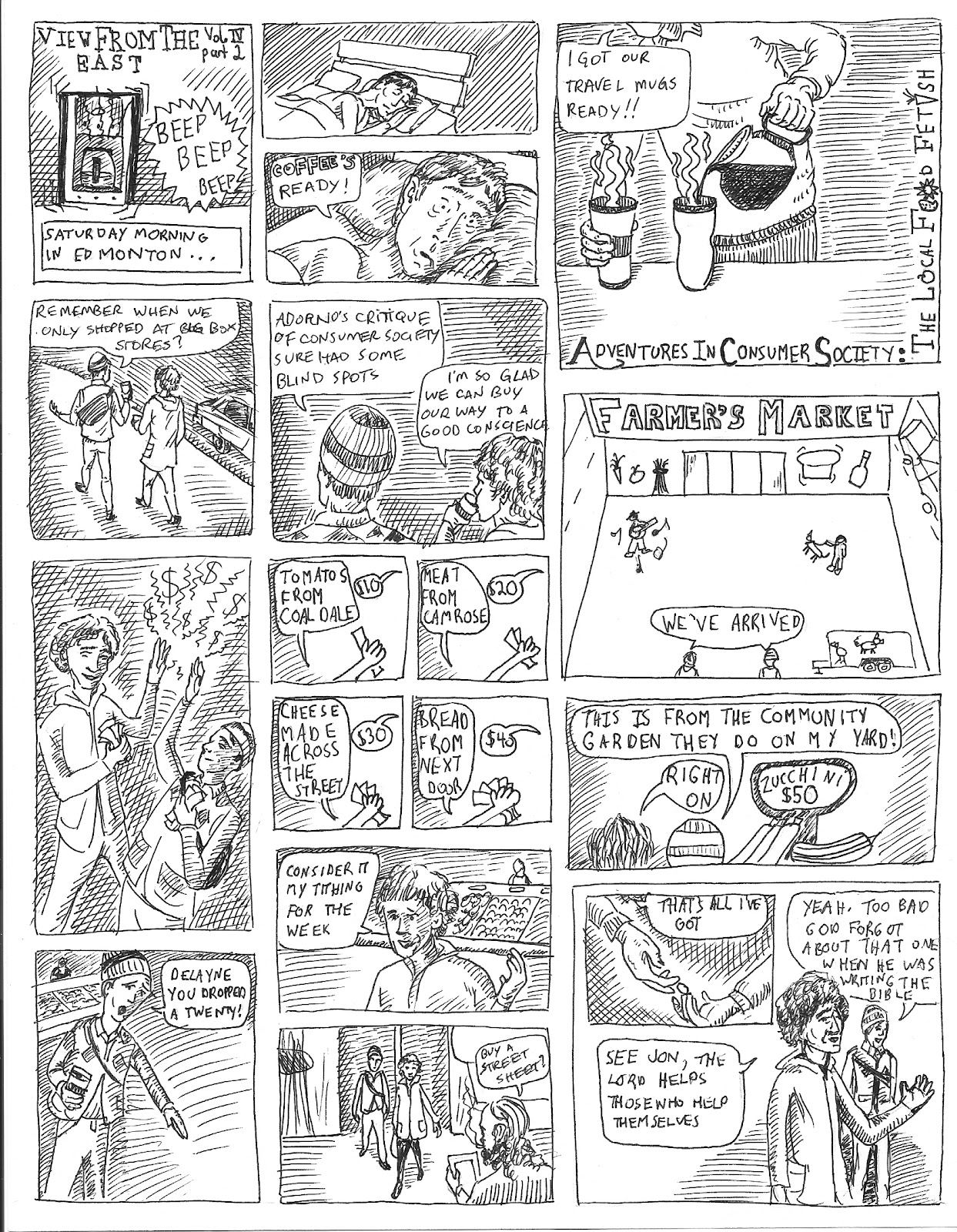
Comix! View from the East returns with Vol. IV

In the off chance that you've actually come across earlier "issues" of View from the East, you may remember that this comic strip is a collaboration between a former roommate (DeLayne) and myself: we write it together and share illustration duties. Originally published in our college newspaper, these narratives are based on our experience living together in Winnipeg (2009-2010), a year after completing our undergrad degrees. In case you'd like to peruse our previous episodes, here are links to Volume 1, Vol 2, and Vol 3 for your viewing pleasure.

Last month DeLayne trained out to Edmonton and paid me a visit. I happened to have a rough draft from the "old days" sitting in my accordion file, awaiting completion. We decided to revise and supplement it with an episode from his visit. The second part ("The Local Food Fetish") is based on DeLayne's recent visit to Edmonton and, I think, puts the first ("The Ascetic Nightmare") in perspective. We've come so far.

(Select image and ZOOM for better resolution)

March 10, 2012

RIP Jean Giraud (aka Moebius)

Born at Nogent-sur-Marne, east of Paris on May 8, 1938, Giraud began after art school training as an illustrator for advertisers and the fashion industry before turning to comic strips. He found fame when he created the Lieutenant Blueberry western character and adopted the pseudonym "Moebius" for illustrations of science fiction books and magazines. As well as being published in top French magazines, he worked with Japanese manga artists, co-produced an adventure of US comic-book superhero The Silver Surfer with Stan Lee, and gave preliminary designs for such films as Alien, Tron, The Abyss, Masters of the Universe, The Fifth Element, and Willow.

Here's a recent video of the man at work: