Showing posts with label best of 2011. Show all posts

January 3, 2012

Retro-spective: My favorite albums of 2011 (5-1)

(Click here for the preamble and for albums 10-6, illustrated and illuminated.)

5. Colin Stetson - New History Warfare, Vol. 2: Judges (Constellation)

Most of the music I enjoyed this past year fit within familiar pop conventions and made use of familiar sounds. Musically, I'm a creature of habit: just as inclined toward repetition as I am toward novelty. Colin Stetson's solo record stands out not only because his vertigo-inducing songs avoid easy categorization, but because he uses unfamiliar sounds to channel the chaos of a forgotten (I want to say "Old Testament") world. To do this, Stetson bypasses most of the studio wizardry that other solo artists normally rely on. No loops here - just a muscular man and his massive machine. Along with his much talked about circular breathing technique, Stetson uses several different mics (variously located on his instrument and his body) to produce a wide range of primordial sounds that actually seem to capture the kind of archaic violence suggested by his (very pretentious) album title. The result is so utterly brutal, at once so mesmerizing and jarring, that Stetson's collection quickly became one of the most divisive and disturbing albums of the year.

4. Wye Oak - Civilian (Merge)

Here's what I wrote about this album back in May. For the most part, I think it still holds true:

It's a soothing, satisfying record: cohesive and gentle, but incredibly cathartic and uncompromising at the same time. It's the kind of record, in other words, that you'll want to listen to all the way through. This is going to sound like the worst kind of cliche, but for me, Wye Oak have found a paradoxical balance, the fullest expression of which can be found in the alt-rock of the early 90s. So it's a little creepy how much this album seems suited to my tastes.  Wye Oak's second proper LP highlights a stunning vocalist (Jenn Wasner), ample feedback, grungy breakdowns and lyrics with vaguely religious themes. For instance, there seems to be an ongoing dialectic between Creation and Evolution in Wasner's lyrics that's oddly compelling. Musically, things appear relatively stripped down (the band performs as a two-piece), but every so often Wye Oak's sound becomes incredibly expansive.

3. Sandro Perri - Impossible Spaces (Constellation)
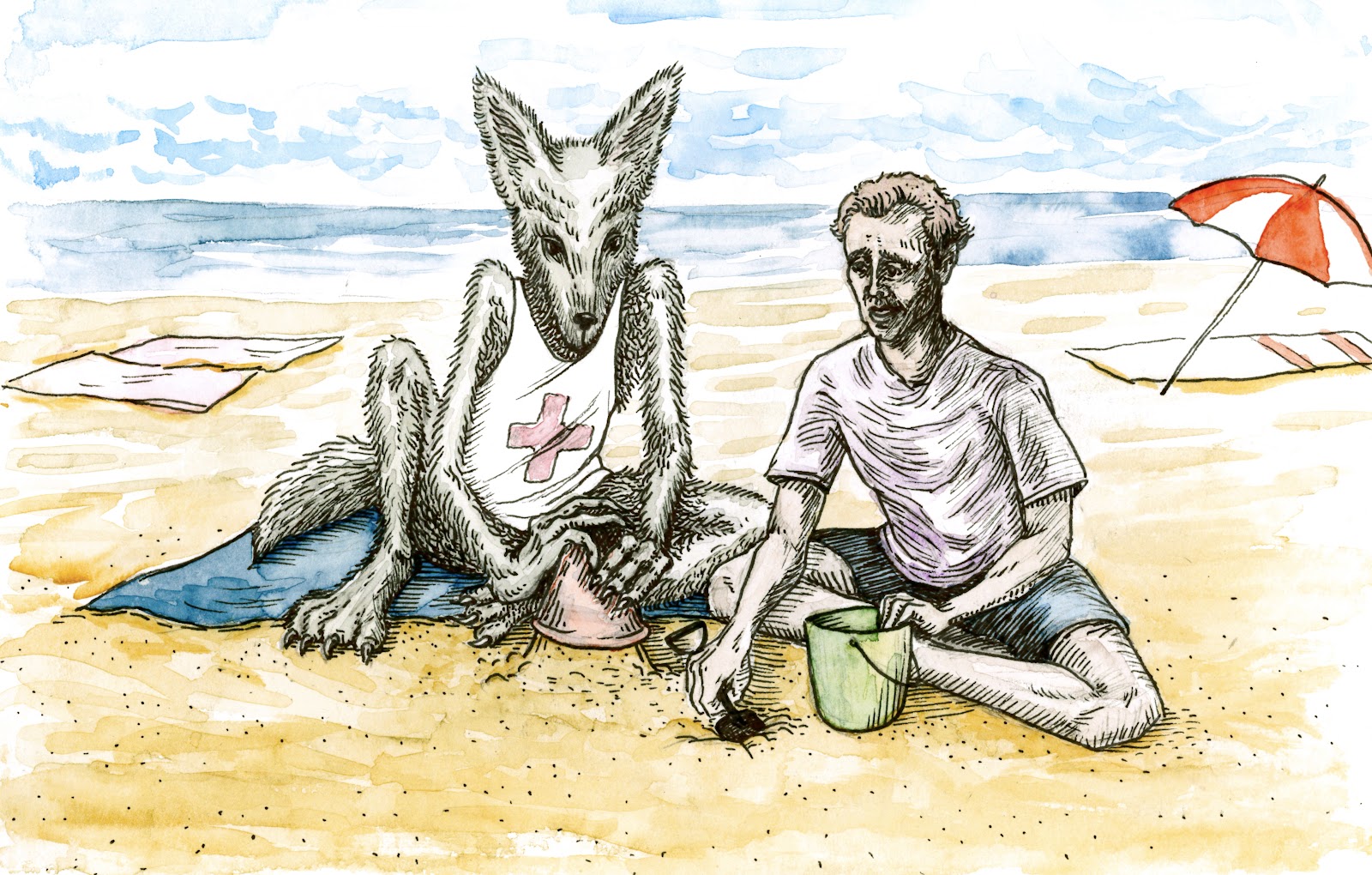


I was introduced to the wispy voice of Toronto's Sandro Perri back in 2006 with his second proper album, Tiny Mirrors. I still like much of what I heard, but at the time I thought it sounded a little too stripped-down, a little too straightforward for a folksy singer-songwriter with clear Afro-beat influences (and a major debt to Arthur Russell). What I saw as shortcomings five years ago were perhaps over-corrected on Impossible Spaces, a cohesive collection of songs I honestly didn't think Perri was capable of. In interviews he's made it clear that he took every one of those five years (since Tiny Mirrors) to work on the new record. And it shows. The grand scope these songs--their dynamic structures and lush instrumentation--is carefully balanced by the intimacy of Perri's softly sung narratives. I tried to flesh out one of them (the ten minute epic "Wolfman") in the image above.

2. The Antlers - Burst Apart (Frenchkiss)


A haunting, absorbing chamber-pop album from Brooklyn's finest students of atmosphere and emotion, Burst Apart demonstrates that there is life after the kind of trauma explored on the Antlers' 2009 debut, Hospice. But if the conceptual overload of Hospice has indeed been left behind, it's only just barely. These songs speak of emotional collapse and relationships that are doomed to fail. Each track sounds as though its teetering on the edge of something terrible--be it chaos, the abyss, or isolation. Combine the apocalyptic tone of Menomena with the sublime reach of a group like Sigur Ros and you might have something close to the Antlers' sound. Despite the deep darkness of Peter Silberman's vision, Burst Apart is oddly comforting. For all the acknowledgments of subjective depravity, ineptitude, and confessions of deceitfulness, Silberman hits on something similar to St. Vincent's Strange Mercy and ultimately refuses to give himself the last word.

1. PJ Harvey - Let England Shake (Vagrant)


As expected, PJ Harvey was rolling in accolades by the time 2011 came to a close. Clearly, I'm in agreement with most critics when they praise Harvey's latest album as her best in a decade, but I'll confess that it's not a record I put on unless I'm in a particular mood. To tell you the truth, I've spent less time listening to and more time thinking about Let England Shake. It's impossible not to. And that's part of the reason I think this album is so strong--it effectively gets under your skin and stays with you. The music is catchy, at times eerily familiar thanks to some well-chosen samples from other artists; but once Let England Shake wins you over, your left to deal with a batch of heavy (and, at times, heavy-handed) questions, the kind we normally try to evade. Back in November, I wrote a lengthy Remembrance Day meditation on Let England Shake that should help to explain why I think this album was so important and so necessary for 2011. I guess I'll leave it at that.

January 2, 2012

Retro-spective: My favorite albums of 2011 (10-6)

This year I've gone a little overboard in my exhibitionism. Alongside the usual long-winded review you'll find original illustrations for each of my ten favorite albums. Some draw on a particular song, others are straightforward portraits; still others aim for something more personal and evocative.

In a year crammed full of nostalgia--from Destroyer's 80s homage to The Horrors' big-haired shoegazing, not to mention the forceful return of early 90s guitar rock via The Pains of Being Pure at Heart, Yuck, etc.--one album stood out for in its effort to draw this kind of memory work--and its politics--into question. But alongside PJ Harvey's meditations on nation and violence, other artists pushed through familiar territory to produce new sounds. Earlier this year, James Blake had the press swooning with his dubstep-infused R&B and Colin Stetson channelled something chaotic and primordial with his multiphonic saxophone, while both Annie Clark (St Vincent) and Chad Vangaalen entered the ambivalent spaces of domestic life with tragicomic results. With every year it becomes more difficult to narrow down and organize a list of my favorite albums--I've pared it down from thirty or so. Strong releases from stalwarts like the Dodos, Wild Beasts, Bill Calahan, The Roots, and Stephen Malkmus require some mention, as do new discoveries like Iceage, Dog Day, Main Attrakionz, Braids, the Weeknd, Shabazz Palaces, Peaking Lights and Jessica Jalbert. For many it was the year of Bon Iver, a charming enough folk-singer who turned out to be incredibly polarizing (producing among some of my friends the longest Facebook debate I've ever taken part in). Meanwhile, Radiohead fans had to grapple with a surprisingly weak showing from a band whose fans have come to expect nothing less than game-changers--besides a viral video, it seemed less an RH album--less a cultural event--than a blip.

I've split the list in half, with the first five following below. I'll try and post my top five in the next several days.

10. Chad Vangaalen - Diaper Island (Flemish Eye) 

It's not his best record, but it's probably his most consistent. If you like restrained guitar noise and conventional folk-rock this is the Chad Vangaalen album for you. It's full of moments that can only be described as "heartwarming" (but in Vangaalen's imagination, I'm sure this kind of description gets at something more perverse or grotesque than sentimental). Although it pays lip-service to domestic topics like child-rearing, relationships, etc., Diaper Island is still full of the wonderful weirdness, humor and creativity we've come to expect from Vangaalen. This illustration is based on one the album's more frenetic tracks, "Freedom for a Policeman." The song would be a straightforward punk jam about a violent encounter with the law were it not for a hilarious bridge/breakdown, where the policeman's blows slow down and we become privy to the psyche of an agent whose enforcement of the law is momentarily suspended--suddenly, at the level of fantasy, something sappy and pathetic comes into view. That's my take, anyway. Vangaalen's at his best when transforms the familiar into something strange and surprising.

9. James Blake - James Blake (Universal)


I'm not usually one for singer-songwriters, but James Blake is in a separate class. A poppier dubstepper, Blake introduced me to the wonderful world of sub-bass--his album also convinced me that I need a new stereo/soundsystem to appreciate the depth of his sound. It all sounds effortless. Sure, it's pretty music with a wide appeal, but each of the songs on Blake's debut retains a degree of darkness that keeps his music compelling, mysterious even.


8. Destroyer - Kaputt (Merge)

Dan Bejar has been kicking it for nearly two decades. In my mind, this is his best album since 2001's Streethawk: A Seduction. Those of us who've been craving layers of ambient brass and woodwinds over top mid-tempo electro beats can pass out with smiles on our faces. The much-hyped 80s motif has found an appropriate home in Bejar's well-oiled hands, and the result isn't so much sentimentalized nostalgia for a wasted decade as it is reminiscence of parties we were too young to appreciate.


7. St. Vincent - Strange Mercy (4AD)

"Forgive the kids for they don't know how to live." It could be a simple accusation, but St. Vincent's Annie Clark spends the greater part of her third album accepting responsibility and dealing with the crushing guilt of her own failings. Part of what makes her so compelling is the feeling that she really shouldn't have to do so--that she's constantly reacting preemptively against what people think of her. Songs like "Cheerleader" "Neutered Fruit" take a confessional, prayerful tone that's anything but comforting: she's constantly putting herself into question, at one point memorably imploring a surgeon to come cut her open. The whole thing seems like a perverse, sacrificial offering--not so much an apology as a window into her own twisted psyche. Strange Mercy is "strange" for a variety of reasons: musically, it's adventurous and unconventional; lyrically, it's honest and evocative. But despite her best efforts to lay bare her own depravity, Clark seems unable to produce anything that's not beautiful, or at the very least, compelling. Indeed, it's strange that this confusing existential mess could be delivered with such force and candor and still require mercy. For Clark, the error of self-interest--manifested in her own guilt-ridden account of despair--is always there, lurking in the shadows. As with Terrance Malick's recent film Tree of Life, Strange Mercy succeeds in showing us how productive the traditional dialectic between nature and grace can actually be. "It's not a perfect plan," she sings on "Champagne Year," "but it's the one we've got."

6. Cymbals Eat Guitars - Lenses Alien (Memphis)

Along with a handful of well-recieved albums from the past year (such as those from The Pains of Being Pure at Heart, Yuck, etc.), this album sounds like it could have been released fifteen years ago and would have had no trouble finding an audience. (Here is where I would normally list a bunch of bands that New York's CEG sounds like, but it's obvious enough.) But as nostalgic retreads of the 90s go, this is by far the most dynamic and well-crafted. It's also the most melodic guitar based rock record I heard this year. The songs on Lenses Alien are the kind that harness and transform the abrasive energy of teen angst into sheer catharsis. That description's a bit overstated, but so is my subject matter. For all the missteps (such as "The Current") and cringe-enducing lyrics (that more often than not resemble bad high school poetry), I'm won over by the unapologetic delivery of Jeremy D'Agostino's vocals. Sometimes he sounds like Conor Oberst in the worst way; other times his belting sounds like a real exodus.

December 13, 2011

top music videos of 2011

Usually I don't have the patience for an entire 4-minute music video. (It must have something to do with the internet, cause my attention-span seems properly drawn-out when I'm consuming other bits of pop-culture.) Below are some of the videos that sustained my pathetically short internet-attention-span for their full duration--a real feat! This is by no means comprehensive (clearly), so before you start questioning the glaring lack of Beyonce on this "list," know that I'm no Beyonce-hater. "Countdown" is a great song and the video is quite impressive; but I've never been able to watch it straight through--it's kind of overwhelming and a little off-putting--but that probably says more about my own anxieties and shortcomings than it does about anything else. Enough with the caveats. Enjoy!

"Cruel" [Directed by Terry Timely] from St. Vincent's Strange Mercy. Domestic life is tough, especially when your stuck in the 1950s, especially when your psychopathic step-kids are calling the shots.


"Fish" [Dir. Kathryn Fahey, Michael O'Leary] from Wye Oak's Civilian. Silhouetted puppets, biblical allusions, and neon lights are combined in this quirky, stunning tale of evolutionary origins.


"Lotus Flower" [Dir. Garth Jennings] from Radiohead's The King of Limbs. Thom Yorke dons a bowler hat and gets freaky. If you've ever seen me dance, this will look vaguely familiar.


"Riding for the Feeling" [Dir. Archie Radkins] from Bill Callahan's Apocalypse. This continuous shot of a soaring ski-jumper uses artwork from Max Gaylon. It might be just one note, but it's one worth sustaining. And that's part of the point: a utopian fight against the ceaseless flow of time. Some peaceful stuff right here.


"My Machines (feat. Gary Numan)" [Dir. DANIELS] from Battles' Glass Drop. A postmodern "myth of sisyphus," or something equally pretensious to that effect. Probably a good thing to watch before you start your Christmas shopping. Also: Gary Numan!


"The Shrine/An Argument" [Dir. Sean Pecknold] from Fleet Foxes' Helplessness Blues. I'm always impressed with animated music videos, but this is undoubtedly one of the best I've ever seen. Made by the brother of FF frontman Robin Pecknold, "The Shrine/An Argument" falls somewhere in-between Where the Wild Things Are and The Lion King. It appears to be all paper-based, but the incredible lighting effects and the grainy, orange tint help to align the images with the nostalgic fantasy-folk sounds of the Fleet Foxes.

October 21, 2011

New Music: Stephen Malkmus and the Jicks

The latest record from the former Pavement frontman has been out for several months now, and I've been putting off writing about it, perhaps because, like previous releases by Stephen Malkmus, it's acquired a rather personal significance--I'm cringing as I write this. I should also mention that it took some time to warm up to Mirror Traffic, perhaps because the first few tracks just aren't very good.

In my opinion, aside from a few duds (always par for the course with Malkmus), it's right up there with his best solo work, and constitutes a real step forward after 2008's less-than-spectacular Real Emotional Trash. The guitars are still prominent but the riffs are better and the poppier fare on Mirror Traffic makes better use of them. Somehow, the Malkmus continues to be juvenile and mature at the same time--he's that crazy uncle you idolized as a kid; the man who now earns your qualified appreciation as an adult. You may at times cringe at his wordplay, but (as with Real Emotional Trash) much of the sentiment comes from an archive of experiences that can only be amassed by middle-age. Malkmus is a family-man, a beloved veteran of indie rock, a recreational drug-user, an emotional screw-up, a witty comedian, and, of course, a guitar god. That compelling mess is all on display here: from the frenetic pulse of a song like "Tune Grief" to the laid-back, tender style of "Share the Red," it could be said that Malkmus calls it in. Indeed, none of this is new for fans of Pavement, even with Beck (another veteran of the nineties) lending his name to the production. Be that as it may, if Mirror Traffic is one of my favourite albums of the year, it's because Malkmus' penchant for melody is still unmatched in guitar-based indie rock, and wherever I'm at in my life, his songs continue to resonate, connect and, ultimately, illuminate the aspects of my life that require a soundtrack, if not a roadmap.

Here's "Stick Figures in Love," one of several tracks from Mirror Traffic that fit that somewhat personal (and embarrassing) description.

July 8, 2011

Summer Anthems 2011

I've recently begun a French immersion program in Quebec City, and can actually feel my aptitude for English dwindling as I write this. Processing every word twice can be pretty exhausting, especially for monolingual anglophones from the prairies. That being said, it's only my first week, and I've already fallen in love with the city. It definitely lives up to the hype.

Below, you'll find two gorgeous videos with music to match. At this point in the summer, you can't go wrong with psychedelic chamber-pop.


And, finally, an electro-pop anthem for all the clubbers out there:

Pictureplane - "Real is a Feeling"

June 22, 2011

New Music: Bon Iver


Bon Iver (aka Justin Vernon) has just released his self-titled follow-up to 2007's For Emma, Forever Ago, an album I never really got into. I streamed the new album last week and was struck by its dense orchestration and carefully crafted soundscapes. Now that it's officially out, Bon Iver (which probably has more in common with the style of Vernon's side project, Volcano Choir) is garnering rave reviews across the board: it's lush, layered, and, like Bon Iver's celebrated debut, seems to capture Vernon at his most intimate and vulnerable. It also features some beautiful album art (above).

Below you'll find Vernon in a recent interview with Stephen Colbert and a performance of the album's lead single, "Calgary." The guy is incredibly likable, and I'm expecting to see Bon Iver near the top of virtually every critic's list come December. It may sound a little too close to Coldplay at first, but don't let his Chris Martin-esque falsetto fool you: this isn't mere sentimental schmaltz. It's friggin' gorgeous.


bi on tcr by yardie4lifever2

May 11, 2011

New Music: Wye Oak, Chad VanGaalen

Of all the stuff I've been listening to over the last month it was Wye Oak's new album Civilian, in particular, that carried me through to the end of the semester. It's a soothing, satisfying record: cohesive and gentle, but incredibly cathartic and uncompromising at the same time. It's the kind of record, in other words, that you'll want to listen to all the way through. This is going to sound like the worst kind of cliche, but for me, Wye Oak have found a paradoxical balance, the fullest expression of which can be found in the alt-rock of the early 90s (I have no problem admitting that the closer an album comes to mapping fragility and aggression simultaneously--like, say, Siamese Dream or Rid of Me--the more likely I am to embrace it). So it's a little creepy how much this album seems suited to my tastes.  Wye Oak's second proper LP highlights a stunning vocalist (Jenn Wasner), ample feedback, grungy breakdowns and lyrics with vaguely religious themes. For instance, there seems to be an ongoing dialectic between Creation and Evolution in Wasner's lyrics that's oddly compelling. Musically, things appear relatively stripped down (the band performs as a two-piece), but every so often Wye Oak's sound becomes incredibly expansive. I've posted my favourite track ("Dog Eyes") below. It rocks pretty hard.


 I've also been enjoying Chad VanGaalen's latest (fourth, I guess) album, Diaper Island. It appears to be tied together by themes of domestic life, but no worries: there's still plenty of weird stuff going on. Musically, however, it's significantly more well-behaved than his previous albums. That's not necessarily a bad thing, especially for those of us who loved Women's Public Strain (produced by Chad last year). Most of the press surrounding the album has emphasized its straight forward rock aesthetic, but Chad's been toeing that line as long as he's been putting out records. He's reported to have submitted over three albums worth of post-Soft Airplane material to Sub Pop for this album, so we'll have plenty of b-sides to look forward to. The record is out May 17, and is currently available for streaming via Paste. I've devoted a lot of time to Chad's previous records, so I'm not going to get ahead of myself and call this his best; then again, I'm not going to pretend that Diaper Island isn't awesome, and I'm sure I'll be posting on it again. The song below is a real stunner. This ain't Bob Dylan's "Sara."


I should probably also mention some of the big guns.

Yes, Panda Bear's Tomboy makes good on the hype, and, personally, I think it betters 2007's Person Pitch. While we're speaking of albums that improve on their predecessors, I've also been enjoying the latest effort from Seattle's Fleet Foxes (Helplessness Blues) and tUnEyArDs' (yes, the mixed cases are intentional) second album, w h o k i l l. In the coming weeks, I'll be looking forward to new music from the Antlers, Wild Beasts, and Gang Gang Dance.

February 23, 2011

New Music: PJ Harvey, Radiohead

It appears to the be the year for English pop artists to engage in political critique -- well, sort of. Who knew musicians could still find their arsenal by tarrying with the pastoral tradition?

PJ Harvey's Let England Shake isn't terribly complex ("How is our glorious country sown? Not with wheat and corn" -- "Our land is plowed by tanks!" Harvey sings on "The Glorious Land"), but musically there's a lot going on. Harvey's familiar songwriting style is stronger than ever (best heard in songs like "Bitter Branches" and "In the Dark Places"), but it seems she's taken the lessons of failed albums like White Chalk and her recent collaboration with John Parish (A Woman a Man Walked By) to heart: here, murky production, disparate soundscapes, and a Victorian-gothic aesthetic merge with reflections on post-colonial England: a nation constantly in dialogue with its own legacy (as she demonstrates on the haunting centerpiece, "England"). Harvey's approach is to play with, juxtapose, subvert cultural resting places with a downright bloody history: into this mix she throws lines from English protest songs, reggae samples, and tons of autoharp. In other words, Harvey's task with Let England Shake is to re-energize the English tradition of political critique. It could have been a heavy-handed train-wreck, but in Harvey's hands (and thanks incredible team she's assembled: Rob Ellis, Mick Harvey, John Parish, Flood, etc.), Let England Shake reminds PJ Harvey fans why we came to love her in the first place: not for her brilliant insights, but for the raw emotion that can only come by looking the devil in the face.


Radiohead's music always gestures toward some kind of late capitalist malaise, and The King of Limbs is no different. Indeed, this time around there seems to be a strong resonance between the natural imagery transparently there (both in the cover art and in Yorke's lyrics) and a recently resurfaced debate over forest enclosures throughout much of Britain. But regardless of its political timeliness, The King of Limbs is a strange animal. As is often the case with Radiohead's albums, early reviews have been typically vague. It's not their best album -- I think we're all agreed on that -- but neither should it be written off as a misstep. The King of Limbs is a good album, but it's also their most idiosyncratic -- only Amnesiac comes close. There's a strong dubstep influence and the more organic elements that characterized In Rainbows have retreated into the shadows only to reemerge in two oddly situated tracks: the lovely, effortless, out-of-place piano ballad, "Codex," and its partner, the echo-chamber folk song, "Give up the Ghost." The rest of the album is comprised of rhythmically complex songs that seem to fold in on themselves; at times, one wonders what the rest of the band was up to during recording sessions. As for immediate highlights, there's the devious lead single (below) "Lotus Flower" (in my opinion, this is one best tracks of the year so far), the very catchy, occasionally clumsy "Little by Little" (which picks up nicely from Amnesiac's "I Might be Wrong") and an album closer ("Separator") that actually does something -- to put it a bit differently, "Separator" is more expansive than what we get on the rest of The King of Limbs: it incorporates a fantastic lead guitar line, releases some (dearly missed) ambient steam, and gets as close to an anthem ("Wake me up") as Radiohead can currently get. We Radiohead fans need not despair. The King of Limbs is full of fine moments. More than anything else, we're victims of our own anticipation.